
Marrakech to Essaouira Day Trip: The Complete 2026 Guide
 If you’ve spent more than a day in Marrakech, you already know the feeling — the heat radiating off medina walls, the relentless motion of the souks, the sensory overload that’s thrilling but eventually exhausting. The good news? One of Morocco‘s most beautiful escapes is just 2.5 hours away.
The Marrakech to Essaouira day trip is widely considered one of the best excursions in all of North Africa. You trade the landlocked chaos of the Red City for a windswept Atlantic port town where blue boats bob in the harbour, fresh fish sizzles on open grills, and the pace of life drops several gears. Same country, completely different world.
Where Is Essaouira?
Essaouira sits on Morocco’s Atlantic coast, approximately 190 kilometres west of Marrakech. Its defining characteristics — spectacular sunsets and near-constant wind — come courtesy of its direct westward exposure to the ocean.
The city has a genuinely layered identity. Phoenicians called it Mogador. The Portuguese built early fortifications in the 15th century. Moroccan sultans redesigned the medina in the 18th century. The result was declared a UNESCO World Heritage Site in 2001. In 1969, Jimi Hendrix famously visited the nearby village of Diabat, and that bohemian spirit never fully left — Essaouira remains one of Morocco’s great artistic hubs.
How to Get There
Supratours Bus — Best for Solo Travellers Seven daily departures starting at 7:45 AM. Tickets cost 140 MAD per person, journey time is around 3 hours including a rest stop, and the drop-off is conveniently close to the medina walls. For a day trip, the 7:45 or 9:00 AM bus is ideal. Bring water and snacks — there’s no onboard service.
Grand Taxi — Best for Small Groups Shared taxis from Bab Doukkala station carry up to 6 passengers for around 600 MAD for the whole vehicle. Split between 3–4 people, this is excellent value and typically faster than the bus. Expect the driver to quote higher — politely hold firm.
Private Transfer — Best for Comfort Door-to-door service costs 800–1,000 MAD one way, or 1,400–1,800 MAD return. Worth it for couples, families, or anyone who values flexibility and a stress-free journey.
Organised Day Tour — Best for Hassle-Free Travel Group tours from around $30 per person include hotel pickup, an English-speaking guide, and a stop at a women’s argan oil cooperative. You’ll get around 4 hours of free time in Essaouira — enough for the highlights.
What to Do: The Essential Highlights
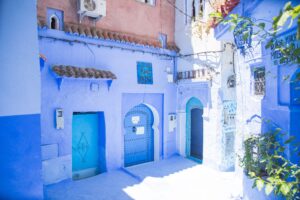
The Medina Unlike Marrakech’s labyrinthine old town, Essaouira’s medina is compact, car-free, and navigable in a couple of hours. It’s laid out in an almost grid-like pattern — you can explore it without a guide and without getting lost. White and blue buildings line the streets (blue being the traditional colour of the Jewish Mellah quarter in the north), alongside art galleries, thuya wood workshops, jewellers, and textile sellers. The atmosphere is calm enough that you can actually browse without pressure.
Skala de la Ville The seafront rampart is Essaouira’s most iconic sight — an 18th-century battery of 19 bronze cannons pointing permanently westward over the Atlantic. Entry is free, views are sweeping, and it doubles as a Game of Thrones filming location (the city of Astapor, Season 3). Walk its length in the morning for quiet contemplation, or return at sunset when it fills with locals and the light turns golden. Note: the ramparts close promptly at sunset.
The Fishing Port Row upon row of vivid blue wooden boats crowd the harbour, nets drying in the wind, seagulls circling overhead. This is a working port, not a staged attraction, and it’s one of the most photogenic spots in Morocco. Choose your fish at the harbour stalls and have it grilled at a nearby restaurant — the freshest, most affordable seafood you’ll eat in Morocco. One caution: port-side restaurants occasionally inflate bills with extras not mentioned upfront. Always agree on the total price before sitting down.
Sqala du Port The 18th-century port fortress at the southern end of the harbour costs just 50 MAD to enter (free on Fridays) and delivers panoramic views of the medina, harbour, and Atlantic coastline. Best visited in late afternoon for the golden light.
The Beach Two kilometres of broad golden sand stretch south from the medina walls, battered by consistent Atlantic wind. The alizé trade winds make it exhilarating to walk but challenging to sunbathe (expect sand in your face). The upside: Essaouira is one of Africa’s premier kitesurfing destinations, and watching kiteboarders arc over the surf is spectacular even if you’re just a spectator.
Suggested Itinerary
| Time | Activity |
|---|---|
| 7:30–8:00 AM | Depart Marrakech |
| 9:30 AM | Argan cooperative stop (30–40 min) |
| 10:45 AM | Arrive Essaouira |
| 11:00 AM | Explore the medina and Mellah |
| 12:00 PM | Skala de la Ville ramparts |
| 12:45 PM | Fishing port and fish stalls |
| 1:15 PM | Lunch — fresh grilled seafood |
| 2:30 PM | Sqala du Port (50 MAD) |
| 3:00 PM | Beach walk |
| 3:45 PM | Shopping in the souks |
| 4:30 PM | Mint tea in a medina café |
| 4:50 PM | Ramparts for sunset |
| 5:15 PM | Depart for Marrakech |
Food and Shopping
What to eat: Grilled sardines, prawn brochettes, fish tagine with preserved lemon — all served fresh from the morning’s catch. For a street snack, try amlou (a paste of argan oil, almonds, and honey) spread on bread. Fresh-squeezed orange juice is everywhere and costs almost nothing.
What to buy: Essaouira’s souks are calmer and less pressured than Marrakech’s. The city is famous for thuya woodwork — fragrant, burled pieces with extraordinary grain patterns. Argan oil is best bought at the cooperative on the route (quality is consistent and prices are fair). Original artwork from the medina galleries makes a genuinely meaningful souvenir.
When bargaining in the souks, start at 40–50% of the asking price and stay good-humoured. Never begin negotiating on something you’re not prepared to buy.
Practical Tips
- Carry cash. Most market stalls and small shops are cash-only. There’s a reliable currency exchange near the medina entrance and a few ATMs in the new town.
- Pack a light jacket, regardless of season. The Atlantic wind makes temperatures feel 3–5°C cooler than they are, and late afternoons can turn chilly quickly.
- Wear comfortable shoes. The medina is entirely cobblestones.
- Download an offline map before leaving Marrakech — mobile data can be patchy on the road between cities.
- Best season: Spring (March–May) and autumn (September–November) offer ideal temperatures, manageable crowds, and beautiful light. Summer is busier but cooler than Marrakech thanks to the sea breeze. Late June brings the world-famous Gnaoua World Music Festival (June 25–27, 2026) — extraordinary, but plan transport well in advance.
Is It Worth It?
Yes. Unequivocally.
The Marrakech to Essaouira day trip delivers a completely different travel experience from anything the Red City offers — fresh ocean air, ancient ramparts, world-class seafood, and a medina you can actually enjoy without being overwhelmed. The 5–6 hours of transit time is real, but so is the reward.
Solo on a budget? Take the Supratours bus and explore independently. Travelling as a couple? Book a private transfer and linger over a sunset seafood lunch. First-time Morocco visitor? Join an organised day tour for context and ease.
However you choose to make the journey, the Atlantic coast is waiting — and it’s worth every kilometre.